Type Spin: alphabet run game
- 4.5
- Rating
- 50.00M
- Installs
- Free
- Price
 Analysis by App-foxy
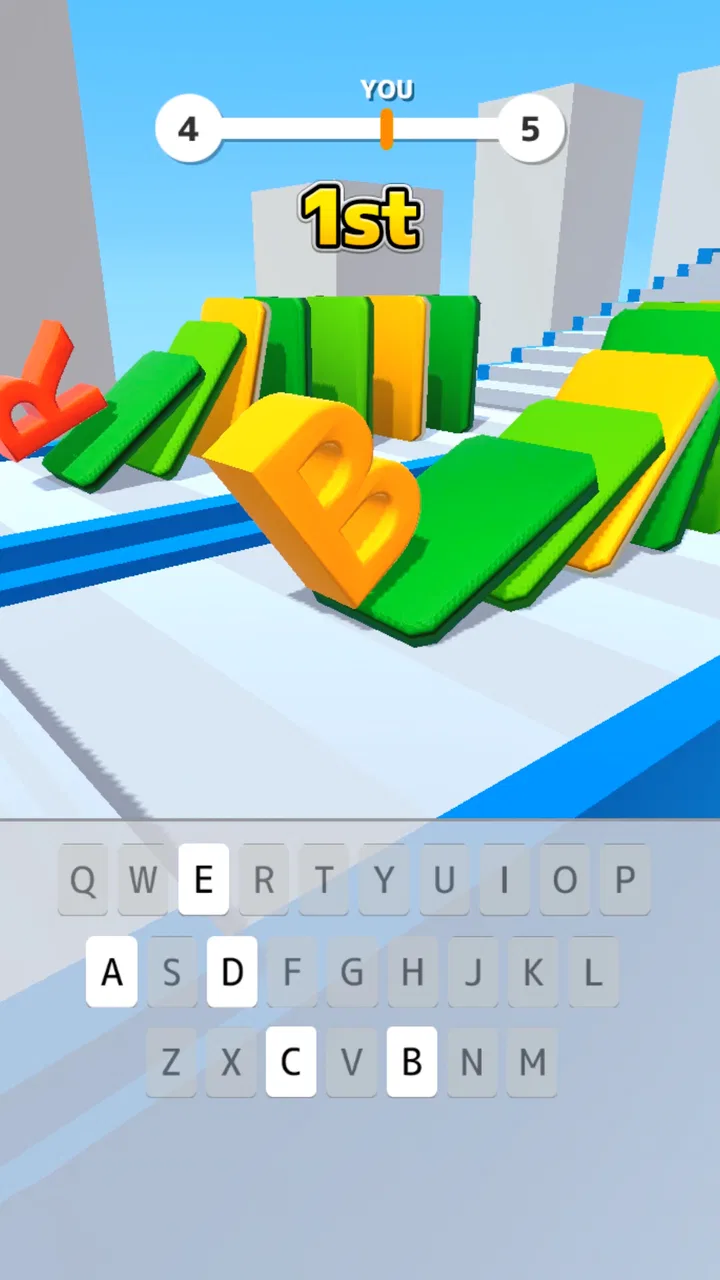
I did not expect a racing game built around spinning letters to hold my attention for long, but Type Spin has a surprisingly clear idea and sticks to it. Instead of steering a car along a track, I rotate an alphabet-shaped character through obstacles and try to reach the finish. The result feels closer to a compact physics puzzle than to a traditional racing game, yet the pressure of moving quickly gives each attempt a racing-game rhythm.
That unusual mix is the main reason to try it. If you want detailed vehicles, long championships, or realistic driving, this is not the right direction. If you enjoy short challenges where timing, momentum, and a little experimentation matter, it can be an excellent casual choice. I found it especially easy to pick up during small gaps in the day, while still offering enough physical unpredictability to make repeated attempts feel different.
What I looked for before recommending it
My first question with a game like this is whether the central gimmick remains interesting after the novelty wears off. Spinning letters is a good opening idea, but the controls need to feel understandable, and the obstacles need to make the player think rather than simply react. In my experience, Type Spin works best when I treat each level as a tiny problem: decide how the letter should rotate, judge the next surface, then correct the movement before the character loses its route.
You May Also Like

 Blood Strike: 2.5 Anniversary
Blood Strike’s Loadouts Turn Every Drop Into a Tactical Gamble
A close look at Blood Strike’s custom loadouts: how fast access to signature weapons reshapes its battle royale rhythm, rewards preparation, and narrows the gap between fights.

 Pandora - Music & Podcasts
Pandora’s Music Is Easy to Start, but Harder to Recover
Pandora’s strength is its low-effort path from a seed to a station. Its weak spot is how much confidence it asks you to place in connection, setup, and quiet recovery.

 8 Ball Pool
 Is Built on Rivalries, Rematches, and Routine
A close look at the rivalries, rematches, shared routines, and unanswered safety questions that turn a quick pool match into a persistent mobile community.

 Samsung Music
’s Quiet Strength Is Playing What You Already Own
Its reach comes less from spectacle than from dependable access to a personal library. That simplicity is both the app’s strongest retention engine and its ceiling.

 AccuWeather: Weather Radar
AccuWeather Review: A Quick, Clear Forecast for Everyday Decisions
For everyday plans, the best forecast is the one you can understand quickly. AccuWeather makes rain timing, radar, and local conditions easy to act on, with a few trade-offs.

 Hill Climb Racing
Why Hill Climb Racing Still Turns Crashes Into One More Run
A tiny car, a bumpy hill and one more upgrade: Hill Climb Racing keeps resurfacing because its simple chaos makes every near-miss feel personal.
More From Our News Desk



The second decision point is the kind of racing experience you want. This is not about choosing a vehicle, tuning a setup, or learning a circuit. There is no need to memorize a conventional track layout. The focus is on the shape of the letter and how that shape interacts with the course. That makes it approachable for people who normally avoid racing games, but it may feel too light for players who want a strong sense of speed or competition.
I also paid attention to how much patience the physics demanded. A physics game can be entertaining when mistakes teach you something, but frustrating when movement feels random. Type Spin sits between those extremes. The character’s rotation can create unexpected outcomes, so success often comes from understanding a failed attempt rather than merely trying to move faster. That gives the game a small learning curve without turning it into a demanding simulation.
For a free game, that balance matters. I can start playing without planning a purchase, and the Teen content rating makes it suitable for older children and adults who want a playful challenge. I would still judge it by the quality of its moment-to-moment interaction, not by the fact that it costs nothing. Free access is useful, but it does not automatically make a game worth keeping installed.
The unusual control idea is its strongest advantage
The best part of Type Spin is that the letter is both the player character and the main control problem. Its outline affects how it lands, turns, and continues along the course. I am not simply pressing a direction to move left or right; I am trying to make the shape arrive at the next section in a useful orientation. That creates a direct connection between what I see and what I do.
This is where it separates itself from ordinary mobile racing. In a typical arcade racer, the important question is often whether I can change lanes or brake at the right time. Here, the question becomes whether a rotation will help the character roll over a gap, climb a surface, or avoid an awkward landing. The game therefore feels more like manipulating a physical object than driving a machine.
A useful technique is to stop treating every obstacle as something to rush through. When I repeatedly fail at one section, I watch the character’s angle at the moment it touches the surface. That small pause in my thinking is often more valuable than tapping faster. The right solution may be to begin rotating earlier, allow the letter to settle, or approach with less momentum. This is one of the game’s less obvious strengths: it rewards observation rather than frantic input.
The same design also creates a real limitation. A letter can behave in a way that feels unintuitive, especially when its corners catch on a surface. Players who prefer immediate, predictable controls may blame the game when a landing goes wrong. I think that reaction is understandable. The physics are part of the challenge, but they also mean that a clean-looking plan can fail because the shape makes contact differently than expected.
Short sessions make it easy to fit into everyday life
I see Type Spin as a good companion for moments when I have only a few minutes: waiting for an appointment, taking a break between tasks, or sitting on public transport without wanting to commit to a large game. Its basic idea is easy to understand before starting, so I do not need to remember a complicated story or a long list of controls.
A realistic example is a short lunch break. I can play a few attempts, notice that I am mishandling a particular jump, and put the phone away without feeling that I have abandoned a larger campaign. Later, I can return and immediately understand what needs testing. That low commitment is more important than it sounds. Many mobile racing games ask for longer sessions, repeated events, or a continuing progression routine. Type Spin is more comfortable when I want a contained challenge.
It also works well for players who like sharing a quick challenge informally. I can hand the phone to someone and explain the basic goal in a moment: rotate the letter and reach the end. That simplicity makes it more accessible than a racing game filled with vehicle statistics, track rules, and upgrade choices. The trade-off is that the game’s appeal depends heavily on whether the other person enjoys physics-based trial and error.
One practical tip is to play with a little physical space around the phone and avoid making rushed movements with the device itself. The challenge comes from the on-screen interaction, not from tilting or physically steering the handset. Keeping the phone steady makes it easier to judge whether an unexpected result came from my input or from the letter’s contact with the course.
What the developer’s approach gets right
KAYAC Inc. has chosen a narrow concept instead of trying to reproduce every part of a conventional racer. That focus helps the game feel recognizable within a few seconds. The alphabet theme is not merely decoration; it gives the character a shape that directly influences play. I appreciate that the identity of the game comes from its mechanic rather than from a large amount of explanation.
The game’s popularity also suggests that the idea has reached a broad mobile audience. It carries a 4.5 average from around 119 thousand ratings and has passed 50 million installs. Those figures do not guarantee that every player will enjoy the physics, but they do show that this is not an obscure experiment with no established audience. I would be comfortable suggesting it to someone who wants to sample a distinctive casual game without paying first.
Its current version is 2.5.8, and the minimum operating-system requirement is Android 6.0. That makes it relevant to people using older Android phones, although actual comfort can still depend on the handset and how smoothly it handles the game. I would not choose an older device solely because it meets the minimum requirement; physics-based movement is easier to judge when the game responds consistently.
The release date, January 12, 2021, is also useful context. This is not a brand-new concept relying only on launch curiosity. It has had time to become a recognizable entry in casual mobile racing, while its simple premise remains easy to understand today. I would describe it as an established pick for short play rather than a cutting-edge technical showcase.
Where other racing games may suit you better
Type Spin is a poor substitute for a traditional racing game if your main pleasure comes from speed, vehicles, tracks, and competition. A conventional arcade racer will usually give you a clearer sense of acceleration and direction. A simulation-oriented game will be better if you want careful control over braking, cornering, or vehicle behavior. I would choose either category over Type Spin when I am specifically in the mood to drive rather than solve movement problems.
It may also be the wrong choice for anyone who dislikes repeated attempts. The game’s physics encourage learning through failure, and some players will find that satisfying. Others will feel that the same obstacle is wasting their time. If you prefer a clean progression where each mistake is easy to understand and correct, a more structured puzzle game might be a better fit.
There is another trade-off involving long-term motivation. Type Spin’s appeal comes from its immediate mechanic, not from a detailed role-playing system or a deep vehicle collection. Someone who needs unlocks, customization, or a strong sense of building an account over time may quickly look elsewhere. I would not install it expecting a replacement for a larger racing hobby. I would install it as a focused physics challenge that happens to use racing goals.
On the other hand, players who find ordinary racers repetitive may appreciate the change in emphasis. Instead of asking which car is fastest, Type Spin asks how a letter should move through space. That makes it a useful alternative when I want the category’s forward momentum without the usual driving framework. It is not better than every racer; it is better for a different reason.
Small techniques that make the physics less frustrating
The first technique I recommend is to separate rotation from progress. When I see an obstacle, my instinct is to keep moving toward the goal. In Type Spin, that can make the next contact worse. I get better results when I think about the landing angle first and the distance second. Reaching the obstacle quickly is not helpful if the letter arrives in a position that prevents it from rolling or climbing.
The second is to use failures as visual information. I pay attention to which part of the letter touches the course and whether the character bounces, catches, or slides. A failed attempt can reveal that I am rotating too late, approaching too quickly, or expecting a flat side to behave like a wheel. This turns trial and error into a repeatable process instead of blind repetition.
The third is to avoid changing several things at once. If I alter timing, rotation direction, and speed in one attempt, I cannot tell which adjustment helped. I prefer testing one change at a time. That approach is slower for a minute but usually saves attempts afterward, particularly on sections where the shape reacts in a surprising way.
These habits also explain why the game can appeal to two different audiences. Casual players can simply experiment and enjoy the odd movements, while more methodical players can analyze each section. The game does not require advanced knowledge, but it leaves room for a more deliberate style of play. That is a stronger design choice than a store summary alone would suggest.
Free access is convenient, but the fit matters more
Because the game is free, the cost of trying it is mainly your time and phone storage rather than an upfront purchase. That makes it easy to recommend as a low-risk experiment. I would suggest installing it when you want something playful and unusual, especially if you already enjoy mobile games built around timing and physical reactions.
Still, free access does not remove the need to choose carefully. If I know I dislike unpredictable movement, I am unlikely to become a fan simply because I did not pay. Likewise, if I want a racing game for a long evening, Type Spin may feel too compact. The sensible approach is to judge it after several different attempts, including one session where I slow down and study the physics rather than rushing toward the finish.
The Teen rating is another point to consider when choosing it for a shared device. It is not something I would describe as a universal children’s pick merely because the controls are simple. Parents should use the age label as part of their decision, while older players can treat it as a casual racing title with a playful presentation rather than a realistic driving experience.
My recommendation for different kinds of players
I recommend Type Spin to anyone who wants a free, distinctive mobile game that can be understood quickly but rewards better timing over repeated attempts. It is particularly suitable for short breaks, casual experimentation, and players who enjoy seeing how a strange shape reacts to obstacles. The alphabet concept gives it a personality that ordinary lane-based racers do not have.
I would recommend skipping it if you are searching for realistic cars, a deep career mode, or dependable controls that behave exactly like a conventional racing game. I would also steer away from it if physics-based failure makes you impatient. In those cases, a standard arcade racer or a more orderly puzzle game will probably provide a better experience.
For me, the deciding factor is whether the unusual control idea sounds appealing rather than whether the game belongs to racing. Its real strength is turning the shape of a letter into the challenge itself. That choice gives every obstacle a little more personality, while also creating the occasional moment when the physics feel stubborn. I can accept that trade-off because the game is quick to start, free to try, and different enough from the usual mobile racers to justify its place on my phone.
My final advice is simple: approach it as a physics puzzle with a racing finish line, not as a miniature driving simulator. With that expectation, the design makes sense, the short sessions feel natural, and the failures become easier to learn from. Type Spin is not the right game for every racing fan, but it is an easy recommendation for curious players who want their next race to be decided by rotation, shape, and timing rather than horsepower.
FAQs for Type Spin: alphabet run game
01What is the objective of Type Spin: Alphabet Run Game?
Type Spin: Alphabet Run Game is an engaging, fast-paced game where players race to type the correct letters as quickly as possible. The main objective is to guide your character through various obstacles by typing the correct letters that appear on the screen. It challenges your typing speed and accuracy, making it both fun and educational.
02Is Type Spin suitable for all age groups?
Yes, Type Spin is designed to be suitable for a wide range of age groups. It's perfect for children looking to improve their typing skills in a fun way, as well as adults who enjoy casual gaming. The game’s intuitive interface and varying levels of difficulty make it accessible and enjoyable for everyone.
03Are there any in-app purchases in Type Spin?
Type Spin does offer in-app purchases. These purchases include options for ad removal and additional customization features. While the game is free to download and play, these optional purchases can enhance your gaming experience by providing more personalization and an uninterrupted gameplay environment.
04Does Type Spin require an internet connection to play?
No, Type Spin does not require an internet connection to play, making it convenient for users to enjoy the game offline. However, certain features like leaderboards and in-app purchases may require an internet connection to function properly. This allows for a flexible gaming experience whether you're online or offline.
05What platforms is Type Spin available on?
Type Spin is available for both Android and iOS devices. You can download it from the Google Play Store for Android or the Apple App Store for iOS. The game is optimized for a variety of devices, ensuring smooth performance and an enjoyable user experience across different platforms.
Pros
- Engaging gameplay keeps you hooked.
- Simple controls easy for all ages.
- Visually appealing graphics.
- Regular updates with new levels.
- Low battery consumption.
Cons
- Repetitive ads can be distracting.
- In-app purchases can get costly.
- Occasional lag on older devices.
- Limited offline functionality.
- Some levels feel too similar.

Type Spin: alphabet run game
Gallery